Tuesday, September 27, 2011

down the coast of Peru; and Lima was lovely

Craig and I are home now and we didn't finish writing about our trip! 

our 3 night stay in Trujillo was just right and we recommend the hotel Colonial which also seems to be a major focus for travellers, as we met up with the manager of our Chachapoyas hotel Revash and Tour agency there, Carlos, the morning we left.  Carlos is such a sweet guy. 

Our last morning in Trujillo, we went out to see the Peruvian paso horse breeder's associations show of the paso, and the Peruvian dance, the Marinera.  This was definitely a highlight.  The marinera is a very sexy sensual dance in the spanish style, the woman wears a full, tiered skirt, and a shawl with peacocks and carries a white handkerchief, the man dresses in formal clothes with a white bolero style hat that he uses to flirt and withdraw shading his face. there are elements of the stamping and posturing from flamenco but the music is peruvian guitar trio style.  For our hawaiian friends, it seems that the peruvian trio style does influence hawaiian slack key and the traditions like wearing flowers behind your ear have some overlap. our female dancer was exquisite and with a radiant face, the man was a cool drink of water and they danced beautifully. but even more beautiful is when they have the paso horse, who has delicate feet and turns on a dime, dance the marinera with the young lady.  The dance is full of coquettish movements, the girl dances barefoot but often goes on point like a balerina and even uses her toes to lift up the handkerchief at times.  the handkerchief hides faces and is used for all kinds of expression.

in the afternoon we had some more delicious ceviche to eat and then we went out to Chan chan. this, you could miss. I know it's a world heritage site and all, but the town is mainly weathered adobe walls and one of the 14 or 15 palaces has been rebuilt so you can walk inside, but too rebuilt for our tastes. everyone who has been there told us you could miss it, well, yes, you could. Skip Chan Chan. in Trujillo I'd say focus on the huaca de la luna, the museum in the gas station, the local small museum, the food and the paso horses.  Just walking around, people watching, or sitting drinking cafes in their many italian style restaurants, is also nice.  also we were very underwhelmed by the coast town of huanchaco, it was not charming and the beach like many peruvian beaches is grey and underwhelming. it's a desert here, few palm trees and no coral / turquoise feel. There were folks wanting to sell us cheap ugly stuff, and shabby underappealing houses, restaurants and hotels. I have heard there are nicer looking parts to this town, a big, old church, we did not see them. the Totora reed boats were, ok.  Friends of ours enjoyed lower cost lodging there and said it is nice in the sunny, high season.

south to Lima.  We took a whole day to see this rather than the option of a comfy overnight bus. It was really nice.  We had a great opportunity which is that on our luxury double decker bus, one of the best brands Cruz del Sur, we were able to get the 'panoramico' seats on the top, in front. There is nothing in front of these front seats, just a huge huge horizon.  The seats are first class, wide and comfy and recline almost fully, and they serve you snacks and drinks. and movies if you are inclined to watch them instead of the scenery.  There are several clean spacious bathrooms on board. of course, they drop the pee right onto the highway so god forbid you have to do anything other than pee... but they have nice open windows out to enjoy the view even from the bathrooms.

Although movies were an option I never even peeked. I was too entranced, watching  the outdoors. the coast was not a disappointment, the scenery of the mountain foothills close to the sea, the surprises of beaches and cliffs and waves and offshore islands looking like Big sur, and every now and then slipping into green hills called lomas which are only green due to the fog on the coast and in September and October, the "spring" of this near equatorial southern hemisphere country, are carpeted with yellow and purple wildflowers as well.

Also it was great to slip into the seven or eight irrigated valleys with their bananas, alfalfa, palms here and there and lots of bougainvillea and other warm flowering vines.  between the valleys, the desert is so very dry that there is no any vegetation, no cactus, no grass, no critters, - just white and black and orange hills depending on the minerals. also now and then a ruin, right by the Panamerican highway, from old civilizations now gone. somewhere along this route if we had had the time & car, we could have gone to see Caral, the remains of the city that is about 5,000 years old from what I believe I have read, as old or older than egypt, which was only investigated in recent decades due to its being a mighty city before peruvians were making pottery. Guess they didn't really need pottery, given that there are gourds and baskets and other ways to manage water and food, and they still had a large extensive civilization that left few traces but was mighty and full of skill.

also even though we were on a huge comfy bus with clean bathrooms etc, the roads had some horse drawn buggies laden with alfalfa and other crops and wood, as well as the usual cars, buses, trucks. our second driver was a bit into playing chicken with one of the other buses and that was not so great but he calmed down after a while.  i do remember however, our bus in the right lane, the bus that was trying to pass us in the left lane, and the oncoming passenger car, off to our left on the shoulder, to avoid being killed. Nice.

At the very end of the trip, near Lima, the buses and trucks go on the old coast road which is literally carved into the side of a huge, huge, sand dune.  below you it falls straight off into the sea. far below is a coast with lapping waves on a narrow stretch of sand. here and there you can see surfers.  Also here and there are people working to keep the sand of the road.  the sand dune stretches way up above you as well as way down below you, like a sturdy cliff but it is not, it is packed dark grey sand. The cars go on the newer toll highway and miss the dramatic scenery I guess.

Getting close to Lima towards the end of the day was a trip also. the environs of Lima which has grown quickly from 8 million about 8 years ago to 12 million now, are full of shanty towns which specialize in making fireworks and prefab houses. I think they taking packing boards from containers in from Asia and make the cutest little one room houses just like a child playhouse, with one door and one window and all of it a centimeter thick. unfortunately these are not playhouses, families live in these perched on the sandy cliffs. also people live in houses built entirely of fiber mats. since well off people in lima dress in layers with scarves around their necks, I cannot imagine that people are very cosy in these thin walled little houses but they have no choice.due to poverty and overcrowding of the migrants in to Lima.

Cruz del Sur actually has its own drivers offering you a taxi ride from their bus station in Lima, so that was a nice thing that would have been  great to realize before we left as I was anxious about arriving in Lima just after dark. our driver Pepe (Pedro Espinoza, phone 941 822 735) was very kind and he also took us to the airport. He did give me a lively conversation about the corruption in the world by rich folks and a little bit of a sad story which resulted in a good tip. 

We splurged just a little in Lima due to last minute not being able to go to the less expensive hotel we wanted so we paid $94 US to stay at the Hotal Antigua Miraflores, and funny that in the US this would be about the price of a motel 6 in a city like Lima.  we bailed on our earlier plan to go by taxi to the wonderful Larco museum. Instead we walked all over Miraflores which I've never really done, enjoyed the central park, the nice restaurants particularlly a good, european style italian restaurant on calle Schell, went down to the fancy cliffside shopping mall called Larco Mar, went to some high quality alpaca stores and later hooked up with los jovenes, our friends Martin and Delphine.  We shared delicious ceviche at AlFresco, and went to see our last ruin of the trip, a huaca or pyramid of adobe bricks right in the middle of town.  We also took in the crafts markets. wow, I am amazed by how much factory made non alpaca and probably chinese made things are being sold as alpaca in those markets. I would personally advise only to buy alpaca from a store like allalpaca.  They do sell some blends even there of alpaca with silk or alpaca with wool so you have to ask carefully. as with many desirable things in this world, now that we are all in competition with middle class buyers from all over the world including asia, the price is up, the quality is different, but, alpaca is still just about the softest lightest warmest fiber that people like me can afford and we enjoyed picking up a few deals.

so that was our trip!  such a great time.  I would recommend this north peru loop so much. of course you cannot go to peru for the first and possibly only time and not go to Machu Picchu. but if you have time and want a more relaxed rich experience without being in the thick of tourist insanity, the loop we did in north peru, from the beautiful museums and ruins near Chiclayo, to the sky high rainforested canyons of chachapoyas and particularly kuelap, to the graceful small city of Cajamarca with its geologic and antiquities treasures, to the high andean towns like Cajabamba and Huamachuco, and then down to the classy colonial downtown of Trujillo, you can see we really enjoyed this. the music, food, ruins, natural wonders and charming folks are so totally worth a visit.

Wednesday, September 21, 2011

What a ride!!!!

We are in our next to last town, Trujillo, which is the 2nd biggest city in Peru, with 1.5 million people.  But you´d never know it by being here.  It is a beautiful city, with lots of colonial buildings, a great plaza, amazing ruins nearby, fantastic museums (one in the basement of a car repair shop), delicious food and not nearly as many cars as you´d think.

But getting here was quite an adventure.  From our previous town of Huamacucho, up in the Andes, it´s supposed to take about 5 1/2 hours to get here.  But apparently we chose the wrong bus company and certainly they chose the wrong bus. It was a rickity old thing and every time it would go over a bump the whole bus would shake.  I´m sure the shocks haven´t been changed in 20 years.  Unfortunately for us, there were to be a lot of bumps along the road.  From Huamachuco, which is about 10,000 feet up, we headed out of town and up, up, up the mountains until we reached 12,400 feet.  Here it was beautiful, like the alti plano in southern Peru.  Just a lot ichu grass and finally we saw some camelids, some alpacas and some vicunas.  Haven´t seen a camelid since we´ve been in Peru.  There mostly down south around Cusco and on down to Lake Titicaca.  At the top of the big pass the bus stopped and all of a sudden the bus was filled with the rather unpleasant odor of an over heated engine.  We quickly got off the bus thinking this thing could explode any minute.  We were next to a restaurant and the drivers were able to get some water and pour it into the engine.  Well, I figured at 12,400 feet the rest of the way would be downhill and we would probably be allright.

So after about one hour of fidgiting around with the engine (after we had been delayed for another hour awhile before because of some roadwork) we were on our way.  No more bad smell of overheated engines.  But after an hour or so of going very slowly down the mountain, the driver stopped again.  There was no bad smell, but he needed to get more water.  During all of this he was calling back to the home office (great cell reception way up in the Andes...just try to call someone from the Sierra Nevada) and they were telling him he should take a picture of the engine and text it to them and maybe they could figure out the problem.  Sheesh.

But we got going again.  The scenery was fantastic and pretty soon it was dark and I saw the most amazing stars out the window.  The Milky Way was brilliant all across the sky.  At one point, when it was totally dark, the driver stopped the bus right in the middle of the road, going downhill.  This on a major road with no lights.  Giant trucks were whizzing by us very fast, blowing the horns, and I could just imagine one of these plowing into our rear end.  Not a happy way to spend an evening.

Again we got going and when we finally reached the plain near Trujillo, the bus was going at a normal speed (after spending the prior 3 hours going about 10 miles an hour using his engine as the brake).  We arrived in Trujillo 3 hours late and a little tired and worn out.  But we made it.

So this morning we spent on a little tour out to the Huaca de Luna, a Moche pyramid (about 300 AD) made out of about 140,000,000 mud bricks.  The great thing here are the murals and wall carvings.  Archeologists didn´t even know these existed until 20 years ago, when during an El Nino the rains washed away a wall and exposed these amazing carvings.  Here are some examples...


Pretty cool stuff.  The pyramid itself has been somewhat washed away by 1700 years of the occasional El Nino, but you can get an idea what it looked like.

After the tour it was time for lunch.  When you´re on the coast of Peru you have to have Ceviche at least once a day, if not twice.  This is where ceviche comes from and today we had a really good one at a restaurant called Puerto Mora. It was ceviche mixta and had fish, octopus, crab, some kind a couple of large shelled things.  It was just the simple kind of ceviche, with a lime marinade and onions.  The place was filled with locals (the first sign of a good restaurant) and next to us was a young family with an 8 year old daughter who was totally fascinated with us.  Not many gringos make it to this place apparently.

Now about the museum in the basement of a car repair shop.  It´s the Museo Cassinelli and it was created 40 years ago or so by an Italian immigrant, named, you guessed it, Sr. Cassinelli.  He was a real collector of ceramics of northern Peru and over the years built a collection of 6,000 fantastic ceramics of all the civilization, from the Chavin, about 3000 years ago, to the Inca.  But his best pieces are from the Moche period.  These are fantastic ceramics...very unusual in their design. What some of these artists came up with was amazing....


And even this piece of homo erotica, where the top figure has a little cantelever thingy that makes him move up and down (close your eyes, children)...


One of the weirdest things was a very old mummy like thing of a fetus that gave me the heeby geebies...


The coolest thing were these musical instruments, including several ceramic conch shells and this horn that was 1700 or so years old.  The man who was showing us around actually let me blow in the shells and the horn.  Luckily, I learned in Hawaii years ago how to blow into a conch shell.  Here´s a picture of the horn...


So tonight we are planning on a nice dinner with hopefully more ceviche.  Tomorrow we´ll see some Caballos de Paso and more ruins.  Friday it´s a 9 hour bus ride to Lima.  I figure that will total about 40 hours on buses this trip. But most have been fantastic.


Trujillo

Trujillo, where we arrived after dark last night,  is up there with great cities, we are really enjoying it.  In comparison with other cities in Peru I´ve been to, which sometimes can feel a little shabby due to their newness and relatively shoddy concrete construction style, this city is beautiful. while the outskirts are new, the main part is old mixed with new, and people are proud of it, and keep it clean. And, it feels manageable, safe (at least in the center of town which is quite extensive), sophisticated,and gracious, there is plenty of classical (and quite beautiful) colonial detail (the city was the first founded in Peru I think, in about 1538 or something, yet lots of modern feel, the climate is nice and mild, the people have been very friendly to us. It´s a university town so there are lots of charming cheery younger folks milling around in small clusters.  And, the restaurants are great, lots of italian influence, good cappucinos, and really really great ceviche.   and about 15 minutes to the south, there is a pretty outstanding ruin!  The huacas de la luna y sol are spectacular. the pyramid of the moon has been developed for visitors in an outstanding way, it is so easy to see and enjoy its fabulous murals and get quite a feeling for what a special place it must have been.  There are other ruins near too, we will see some tomorrow.

Yesterday, we were still high up in the Andes, in Huamachuco.  at 1 pm, we got on a Tunesa company bus, which is supposed to be much safer than the other line,Horna, whose drivers apparently race down the mountain.  However, they pulled this particular bus out of their dustbin.  we should have known from its shabby interior and the dark, dark cloud of smoke from its tail end that we might be in for it.  Unlike the road from Cajamarca to Huamachuco, which was a pleasant pastoral dream,the road from Huamachuco back to Trujillo is not for the faint hearted, not because of the steep walls we experienced in our Chachapoyas to Cajamarca trip but just because you go up so far, from 10,500 feet in Huamachuco up to about 12,400 at the top of the pacific crest, then,  down to 9,400, then back up to about 11,000 then down down down forever to see level.  Normally this takes 5 or 6 hours, so we were expecting to get in to Trujillo by dark, and there are lots of scary stories about the outskirts of Trujillo after dark.  In our case unfortunately, it took, um, 8 hours.  Why:  first because the entire first 2/3 of the route are bumpy ardous dirt track made worse by our buses aged suspension and the recent very heavy rains, which made it slick and rutted and potholred, second because we had to stop for an hour at 12,300 feet in the intermittent rain for roadwork to be completed and then, sadly, because our bus overheated (with a great stinky smelly steam explosion)  and all the way down the 4% grade, whenever there was a flat spot, we had to stop to add more water.  And there are very very few flat spots. it was rather dramatic! especially once it got dark and you could see the milky way in its splendor and wondered whether we would ever get safely down without the bus engine blowing up.  Also, we have learned, when on a bus in Peru, if something goes awry, do not expect to be told any details.  We got all our details from the ladies who came on board to sell bread, or by overhearing the driver and his assistant yacking loudly on their cell phones with mechanics in some distant place trying to figure out if the thing was safe to drive on,or not.   Ah well. All is well in the end and we made a new friend, Matt the peace corps guy, and said goodbye to our friend Javier the Lima tourist who we had been with in Huamachuco.  So it was fun and we got safely into Trujillo and safely into town to the Hotel Colonial.  The hotel colonial (double, 90 sols= has parquet floors in its open spaces, large open sitting rooms with charming 1800s type furniture and some open patios.  The air is cool due to morning and evening fog but warm midday and has a nice, oceany feel to it.  very nice. Taxis  blare, traffic is rather zany, but the town is mostly 2 storied colonial type buildings and there are lovely old mansions and churches as well as modern stores.

By the way, in the future, this track from Huamachuco to Trujillo or vice versa should be getting better and better. even though it´s mostly dirt now, it has been widened and graded and will be paved in the next few years. I am sure in drier months and/or with a good bus it would be fine now, but, because there are some very very profitable gold mines at the top of the hill, that need oil tankers and food going up all the time, the push  is on to make this a good, fast road.  Soon, it sould be pretty easy to do the circle that we have done, from Chiclayo to Chachapoyas to Cajamarca to Huamachuco to Trujillo, in pretty decent comfort. right now, just a few rougher spots.  


So far here in Trujillo, we have eaten, slept well, eaten, had great fotos with tiny kids in princess costumes and inca costumesmade from plastic bags and foil, seen a nice parade by the same kids around the huge main plaza in honor of the environment, gone on a nice tour to the ruins, eaten some more (fabulous mixed ceviche with all kinds of fresh seafood an fish in lime with red onions and parched corn and fresh corn), had a great time buying pastries (alfajores, which are fluffy and light, kind of like a marshmellow cookie but indescribably better, and, a Maria something or other with chocolate and vanilla in a light fluffy bar), at a bake sale from future hotelier students, had great fotos with a laughing cloud of high school students at this same technical school,, eaten some more, shopped a little (for shoes and cotton and whatnots, not finding much) and then one of our best experiences, going to a collection of preinca ceramics by an italian collector who is now in his 90s, which is in the basement of a Mobil gas station. on display are 1,600 moche, cajamarca, Chavin and other culture potteries, all in one small room lined with 4 shelves and lots of shelves in the middle. the lovely, lovely ceramics in the form of all kinds of animals,domestic scenes, and even pornography are on shelves with fishing line keeping them from falling off, you could touch them although you are asked not to, and,the sweet guy minding the place actually let Craig and this other french guy play a number of these ceramics which are musical instruments.  and he showed us the potteries in detail. it was so much fun. they are so beautiful. the moche in particular specialize in capturing daily life and sensitive human facial expressions.


Our plans for tonight are to eat some more great local food, maybe have a pisco sour, not sure. tomorrow we will probably go see a display of how a Peruvian paso horse (and its rider) dance the Marinera with a lovely young woman, and then, we may take a taxi to the village next to the Moche ruins to watch people make copies of the ancient ceramics (and probably buy one) and then have some more ceviche and then go out to see Chan Chan. Then we might stay up to go hear live music at a pena that starts at 11 pm until 2 am. then the next morning we will be on one of Peru´s premier bus lines, Cruz del Sur, in the ´panoramic´seats at the front of the top floor of the luxury 2 decker bus, to go down the peru coast 400 miles to lima. on board are a bathroom and lunch, the seats are cozy and wide and the whole journey for the two of us costs $35 U.S. much cheaper than airline and if it is like our experiences of Peru buses so far (except for yesterday´s squib) we expect to enjoy it very much!  Bus trips in Peru so far have all been so beautiful, yesterday´s included, that is it like seeing a dramatic movie, like the huge 3 d Imax ones at the Smithsonian, that is so spectacular you do not want to read or nap because you may miss something great.

Monday, September 19, 2011

Another Chicha, Please!

One of the great joys of traveling is when the totally unexpected happens.  That serendipitous moment that stays with you for the rest of your life.  This happened yesterday in the small town of Cajabamba, about a 3 hour bus ride from Cajamarca.

Some Belgium folks that we met told us that we had to got to Cajabamba on our way to our destination town of Huamachuco.  We would arrive on Sunday, when Cajabamba has a huge market that sprawls all over the town.  We left Cajamarca early and for three hours on the bus had amazing views of Andean mountains and valleys.  These aren´t the gigantic Andean peaks around Cusco and the Sacred Valley, but beautiful rounded mountains with farms going up the sides.  Small villages are everywhere and one of the villages we passed had a livestock market with lots of cows, bulls, pigs, goats, sheeps and chickens for sale.

When we finally arrived at Cajabamba, we discovered that practically every street in town was torn up for sewer work.  Even the town square was totally blocked off with blue tarp and was being reconstruced.  The sound of very loud trucks, backhoes, and those hand held things that tamp down the dirt was everywhere!  Que lastima!!.  It was horrible and I was so bummed that we came to this town.  So we decided to forget this place and get on the next bus to Huamachuco, our original destination.   The next bus would leave at 4;30, or 4 hours from the time we arrived. 

The market was going gangbusters and indeed it spread all over town.  Many ladies in the local straw hats were selling everything you can imagine.  Many had potatoes, a local product, many kinds of which I have never seen. 


We wandered all over town and after awhile heard music coming from high on a hill.  Down a large staircase came a bunch of young women and girls, all dressed up in what I can only describe as chicken outfits.  They were covered in yellow feathers and were followed by a 5 piece Peruvian band of flutes and drums.  We followed them down to a house, where they all went into a courtyard where there was already some kind of party going on.  We looked in the door and were immediately invited in by a local guy, a lawyer named Manuel.  We watched the girls dance to many songs played by the band (pictures are on our Facebook page) and were handed a plastic glass which contained a yellow liquid...the famous chicha of the Andes.  Chicha is a beer made from corn that has been made here since at least the time of the Incas.  It tastes a bit sweet and bitter and is quite tasty.  It was a bit of a risk since this is made from the tap water, but I figured what the hell.  All the big wigs of the town were at this party, including Mr. Mayor himself.  Mr Mayor was taking pictures of us, as I am sure it is unusual to see a foreigner at this party, and just a foreigner in this town at all.  They were all very nice and more chicha was offered and drank, the band played on and the girls got to eventually stop dancing and eat some lunch.  So you see, you just never know.  What started out as a kind of bummer turned into one of the highlights of the trip.

So were barely made our bus to Huamachuco and had another beautiful ride of 3 hours.  Huamachuco is a town that is barely visited by tourists, although it has two great ruins, Marcahuamachuco and Vircochapampa.  It also has the largest town square in all of Peru and this square is filled with topiary of things like llamas, conquistadors and a kangaroo.  Don´t ask, I have no idea.

The main ruin to see is Marcahuamachuco, a huge fortress perched on top of a 10,000 foot hill above town.  Archeologists don´t know much about it, except that it dates back to around 300 AD.  When we arrived at the hotel, we met a nice Peruvian tourist from Lima named Javier.  He said we love to come with us, so this morning we all took a combi (local mini bus absolutely filled with people as much as they can squeeze in) for the 10 minute drive to the base of the hill.  From here, it was a one hour 900 foot climb to the ruins.  When we signed in, a local guide and his brother took us around the ruins, which stretch about 3 kilometers across the top of the hill.


The place is pretty impressive and we spent about 3 hours walking around.  But finally it was time to start the long path down and then the long walk into town.  Lucky for us, when we were on the road a pick up came by and picked us up.  They even took us right to our hotel!  It is here I would like to mention how friendly Peruvians are.  Except for the occasional robber, Peruvians are friendly and very polite.  I really like the people here.  They are always willing to help you and are all very interested in who you are and where you came from.

Now it is time for a short word from our sponser.  There is one special food here that I have learned I cannot do without.  This little item has given us energy when we were feeling low and just makes you feel good.  It is just about the best chocolate bar on the face of the earth and I have to admit we have introduced this little gem to a couple of fellow travelers and they, like us, have become addicts.  This is the Sublime chocolate bar, with peanuts.

 Okay, back to today.  This afternoon, fairly late, we decided to hike to another ruin, Viracochapampa, about a 45 minute walk from town, down a steep hill.  We walked through back roads past small houses with folks doing their daily stuff and eventually followed what we later learned was part of the royal Inca road into the ruins.  We were met by Pedro,  the very polite and well uniformed guide and caretaker of the ruins.  He had us come into a little room, dark with dirt floors, where we filled in the usual book, who we were, our nationality, passport number, etc.  Then we led us around the ruins explaining everything very well in his very polite manner.  Unfortunately, it was starting to get dark and it was starting to rain pretty hard, and we had a long slog up the hill back to town.  By this time is was absolutely pouring and we were lucky to hitch a ride in a taxi.  But the taxi, although he tried very hard, just couldn´t make it up the dirt road.  So we had to get out and walk, along with a local lady who was in the car.  She just shot up the dirt road, although all she was wearing were sandles and we were wearing hiking boots with Vibram soles.  We finally made it to the top of the hill, absolutely soaking wet and were able to get a local tuk tuk (called moto taxis here) who took us to the hotel.  So here we are, tired, wet and hungry and it´s time to go get something tasty to eat.  You see, we forgot to bring a Sublime to the internet cafe.

soaked in Huamachuco

hard to believe 3 days have gone by since the last time we blogged.  Tonight, we are soaked but happy in the pleasant little high altitude city of Huamachuco, a place where tourists hardly ever go.  we have been to two wonderful ruins in one day, Marca huamachuco which is an awesome ancient ruin that sprawls more than 3 kilometers across the top of a huge mountain bluff, and Viracocha pampa which is a more recent ruin on a valley floor and the Inca royal road that went from Quito, Ecuador down through Cusco goes right through it.

anyway, back to Cajamarca. our last day in Cajamarca, Saturday the 17th of September, we enjoyed the architectural beauty of this city.  There are some old complexes of old church and old hospital, both the outsides and insides are great examples of colonial architecture, with facades sculpted in stone flourishes, big wooden doors, coats of arms, and the hospital full of little stone niches where the sick folks had to hang out while being preached to in hopes it would cure them.  We also walked up and down some of the steeper streets which are part stairs and which are pedestrian and which host tourist shops, our first we have seen! we met a very sweet man, Warren Gutierrez, whose mom was English and he said 20 years ago he and his wife started up again the weaving tradition in the area. many have copied him, there are beautiful things made of the small strips of cloth that are handcrafted from beautifully dyed sheeps wool.  And in the evening we went with our newfound pals to our third in a row of extremely tasty dinners, this time Don Paco, and I had the best choice of the evening which was a delicious duck in an elderberry sauce accompanied by good pasta with some kind of alfredo type cheesy-parmesany sauce perfectly done.  and we again had Castillero del Diablo wine.  we had our third night at the comfy hotel Los Jasmines for 80 sols a night which is $25 for a clean nicely decorated room overlooking a garden in a colonical house.

In the morning, Sunday, we started out at 8 on a local bus through the extensive flat valley of Cajamarca with its alfalfa and cabbage and other crops, then wound up and over hills, on the nicely paved roads that now connect through many smaller villages and the town of Cajabamba and the city of Huamachuco.  The landscape continues to amaze us. From Cajamarca we wound over a modest mountain range down into a river canyon which is a tributary of the Maranon which we went through on our way from Chachapoyas.. This took about 3 hours, but probably a lot of this was due to stopping to let off folks.  Also in one town, San Marcos, we took a detour off the main paved road down into the livestock market, which was basically several open blocks of cows and horses and donkeys milling around.  Descending from here into the canyon  was beautiful. although this tributary was dramatically deep, the road made a much more gentle descent into pretty arid mountain country and then into a wide wide valley with lush irrigated fields of warm weather crops, like sugar and bananas and corn.  There was nothing scary, only pleasant views.  On the far side of the valley - the paved road did have to cross the broad, slow river in a ford, there is no bridge - the road climbed up again to the town of Cajabamba. this entire journey of 3 hours cost us only 10 sols which is about $3.30 US.

Wow, what a neat little place. its on the side of a eucalyptus laden hill and overlooks the beautiful valley so the hills around have some steep exposed cliffs and far above some basalty mountain tops, and below, the river valley is lush and green. We arrived at noon. and we had meant to stay here and ordinarily it would be awesome. it has charming streets and on sundays there is the added charm of its becoming the local marketplace for hundred of Andean folks, the women wearing layered skirts of velvet and brocade, with silky blouses and dark wool wraps with a little border of embroidery along the edge, and the nicely shaped white straw hats. 

Unfortunately, government money is building new sewer and water lines so about 60% of the streets and the main plaza were being redone and were impassable and filthy! even on the nice streets and the pedestrian streets, dusty footprints were everywhere. so we quickly decided to move on later in the afternoon to Huamachuco. the fancier bus was all full up but we were able to get the last seats on the last bus out of town, at 4 30 so that gave us time, after locking our luggage up in the room that serves as a ticket office, to explore the market, and get some food.

The streets were full of small individual market stalls with blue tarp roofs and andean people were everywhere. mostly they were tolerant of our picture taking.  there was a nice big indoor market. and in the town there was also a classy restaurant or two.    our first choice, which had a nice interior courtyard and the promise of tasty cakes, was empty of anyone so we moved on to a restaurant where we got nice trout on the usual plate heaped with french fries and rice. I cannot believe how much carbs people eat here.  People are gracious, our neighboring table was an official looking police type person who tipped his hat to us and smiled.  a bit later we went back to the particularly charming place and had the nicest cappuccinoes with vanilla flavored thick, thick whipped cream and tres leches cake which here in Peru is particularly moist.  the owner of the restaurant, very very sweet, actually gave us a little gourd carved as an owl as a little gift.

by this time we only had about an hour and a half left till our bus would leave, and I followed some kids with a donkey out to what I thought would lead out of town. suddenly andean music filled the air, above us up a very very steep road was a flat churchyard of some type with what looked like dancing. and next to us on the road, was another live band playing inside a deep courtyard.  This was a brass band, and we peered in and saw lots of folks eating, and drinking chicha, and then a nice white haired lady very graciously got up with her partner and did a very stately dance, very sexy and fun to watch.  the folks inside kept waving us in. but we were a little reluctant and went a bit up the road. just at the right time, as down came a group of about 8 young teenage girls dressed in little yellow feathered hats and capes and matching yellow sweaters and andean skirts, dancing and singing in a call and response with their musicians who were 5 flute and drum players. it was so cool.  they sometimes fluttered their white hankerchiefs around, a very common part of peruvian dance.  the tune was definitely andean in tune and rhythm, however, they sang in spanish not quechua and they had so many verses. turns out the whole day was a celebration of the saint up in the higher church, a barrio meaning local neighborhood affair. they came down the street and then went right into the courtyard we had been spying on.  they continued to sing and dance, and dance around in little circles waving their skirts forward and back.  and look at us a little nervously.  the folks waved us in again and we accepted!  so there we were in a little courtyard inside its snug adobe walls with about 40 or more folks, and we were offered chicha the local beer and we accepted it, (yes it was a bad idea and I have gotten sick but so what it was so fun) and also we had the non alcoholic form, purple chicha. and they brought us huge plates of food hawaiian style, the usual fare here which is a mostly bone piece of incredible tough mutton on top of rice and fried potatoes.  but since we had just eaten we could not accept. the main guy who had waved us was referred to as doctor by his pals so I asked but he was a local lawyer. he in turn introduced us to the guy who the dancing girls started honoring by piling all their white handkerchiefs around his neck. He turned out to be the local mayor. everyone was so nice to us, they encouraged us to film the dancers and take pictures and in turn they took pictures of us. I think we made their day and they made our day. it was so great. with great reluctance we left to get our bus, but not til Craig got some very warm hugs from the local alcoholic guy.  Did I mention in this courtyard was a nice house and several shed areas, the women were in the far corner cooking, and above the house on the hay covered hillside, even more people were sitting looking down. very picturesque.

So, then at 4 ish, we unlocked our luggage and carried it down the street to where the bus would actually load.  so many things were loaded in the bus, like bedframes and metal bars.  young boys got on to sell us stuffed potatoes which we bought, and a woman with jellos. the bus was packed, every seat taken and ultimately the aisle entirely filled.

This next ride, was probably the most beautiful I had this trip. we went up and over the side of the mountain often skirting along it at the same altitude, past the most beautiful quilt of golden hayfields and green pastures and green crops.  lots of shepherdesses in the local costume bringing their flocks home. the soil has a yellowish color and so do the local bricks and rooftiles. the sun was getting low and the color of the fields, houses and mountains was phenomenal.  so many people as it got dark moved out to sit on a ridge with their families, often with a blazing outdoor fire. the houses are snug adobe with so few windows that I guess folks want every minute of sun. it was mellow light and it was absolutely entrancing. the road was still good, however this was an even more local bus so we made quite slow progress, even at one time coming to a complete stop in what was now darkness due to some unexplained stopped buses ahead of us.  just as dusk fell also, we went entirely around a large andean lake which the locals love to visit for fishing and picnics. finally we wound our way into the town of huamachuco and got a local 3 wheeled moto taxi to our hotel on the square.  It was cold!  We are at about 10,000 feet here and the air does not retain warmth when its dark.

This is not, not, a touristy town. our little hotel, hostal huamachuco, (60 soles or about $22) is plenty clean with nice hot water and some character, several courtyards and we are way at the back where periodically this afternoon in the patio we heard the unmistakeable bleat of a sheep, somewhere.  the local square in front of us is huge because it is one half of the original inca squares which were immense. and it is filled with sweet topiary figures of llamas, sheep, rabbits, kangaroos, and other figures. there is a stream of local traffic but this is almost all the local 3 wheeler motos and it´s good.  late at night they did play rollicking music on a loudspeaker but this did not bother us.

Today, we got up early and teamed up with a 29 year old tourist from Lima named Javier. we have had such good luck. we went to the market and had a somewhat nauseating breakfast of sheeps head in broth with rice and or noodles, and then looked around for a ride. we were going to share the cost of a car for the day, about 70 soles, to take us up the mountain to the ruins of Marca Huamachuco, however, Javier and I convinced Craig that taking a combi minivan would be okay and off we went, with all the locals, about 5 km out of town to the entrance to the ruin. some of our books discuss this road from this point as being a 4wd disaster, but not so.  in recent times the road to the ruins is nearly all paved, only the last few km are well graded dirt road, and we got off at the lower entrance to this road at the highway and walked about 3 km steeply up, up, up. it was gorgeous. the only thing that mars the local views is the gold mines in the distance which are all strip mines. soon we realized the mule road would be more direct than the dirt road and we went straight up, up, up, that.

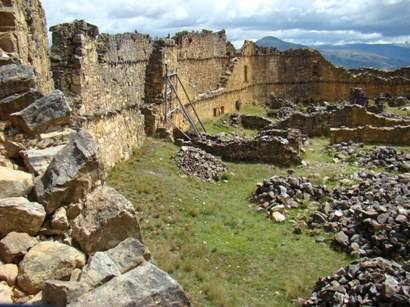
 Marca Huamachuco is on the flat top of this mountain. and once you reach the end of the road, the ruins begin.  they go on and on for another 3 km. so we got lots of walking in and the entrance was free and we were escorted around by various friendly folks and we met two of the local professionals working on the site, a man and a woman who are part of the Global Heritage Fund from Palo Alto and they were also very welcoming.  one of the guards got a little bit directive wanting to hurry us a long but we just ambled around marvelling at these beautiful extensive castle like buildings which are, some of them, 1,400 years old. it was so great.  these are large, large castlelike structures many with double walls and some are huge round buildings like stadiums with lots and lots of rooms and structures inside them.   the walls match the local cliffs and in the slightly overcast day it was sometimes hard to tell the walls from the cliffs. among the ruins, locals still live so shepherding and wheat threshing were going on here and there.

we were lucky enough to get a ride down in the back of the workmens truck all the way to town! so instead of walking back 9 km, we were back in a flash.   after another tasty trout lunch in a restaurant on the square, and some more exploring in the town including the local museum, we got together with Javier again and this time walked out of town, down the canyon, to another set of more recent ruins which are Huari and Inca, on a flat area in the valley called Wiracocha pampa which means the field of the sacred ones or the field of the lords.   the local officials overseeing this were very kind to us, made us sign several ledgers recording where we were from and then took us out into the ruins and showed us the inca road. the ruins are also extensive here, and they have been interplanted with plantations of eucalyptus trees by the locals.

suddenly, the sky turned dark, rain began, then hail, then rain in true earnest!  we thought we were very lucky when a local car functioning as combi picked us up, and it only had one passenger a very nicely dressed andean lady in a shiny pleated blue underskirt, bright top skirt, shiny blouse with lace edgeings. but, alas the rain was fierce the adobe road turned slippery slidey and ultimately we had to get out and slosh up the hill. the nice andean lady was able to run up much faster than us, in her barefeet in sandals.  we slipped and sloshed up and by the time we reached the top were so incredibly wet. as I write now my legs are still soaked although my feet are toasty in the hiking boots and I have changed to a new top and fleece.  the streets are still shiny with rain but the town is plenty active. we are really enjoying our little stay in this place.

but, as our friends who were here before us told us, it´s not for tourists here. it took about a day to even locate the small, free museum and get some more info on things to do. the nighttime has very few tasty restaurants and everyone of them is focused on fried chicken it seems. people do their eating in the midday. we do hear there is a pizza restaurant and we are headed there next.

tomorrow if we are lucky we will go up the mountain to a high valley with lovely lake, a herd of vicunas and some nice sections of the inca royal highway which are preserved because they are all steps, straight up, into the mountains. then in the afternoon if our laundry is dry we are getting on another bus down to Trujillo, a colonial city on the coast near some great ruins.  this bus, 6 hours, costs a little more, 25 soles, more than the 20 soles total we paid to get from Cajamarca to this place.

this area is so recently opened, it was quite easy to get in but the books describe it as far down slow dusty dirt roads. not so, it is paved all the way both ways in. and it probably will soon become a more popular part of the tourist trail since it has such neat, but undeveloped, ruins.

A bit more tourist info for this town.  The actual Hotel colonial is not on the square, if you are on the top of the square looking down, go down the street to your right.  there is a laundry right across the street from that hotel. our hotel Hostal huamachuco was nice enough, however they told us there was not a laundry so that they could wash our stuff.
On the square no one knows about any internet spots but along the street at the bottom of the square, if, looking down on the square you were to go to the left, there are several and there are more down near the market and a few more above the square. 
The market is about 5 blocks down and is very pleasant.
The museum is a bit hard to find. basically the large square slants slightly downhill. about halfway down on each side it´s bisected by a streed which on one side is a nice pedestrian street (and on that side, about a blok down, is actually the office of the Marca Huamachuco / global heritage fund folks,and there a man named Percy was very helpful) and on the other side of the square it´s a street but about a block in is another tiny square and the museum which is small but free and really very nice.  A guy there, Henry, was trying to help us arrange futhre travels, espeically up to a high altitude valley Coshuro where there is a lake, a breeding program for the rare elusive vicunas, and a part of the inca road which is a staircase.  We were not able to arrange it but apparently it is very worth it up there, and also worth it to go out to some hot springs about 90 minutes away by combi.
I don´t know where the Horna station is, but the Tunesa station where we will leave from is just a block below the square on a side street. easy to get to. we came in on the cheaper bus from Cajabamba, Los Andes bus company and it had a station to the east side of town probably about 5 to 8 blocks or so from the center.  not sure exactly. 
for the best food I would probably try the real Hotel colonial. do not go to the colonial restaurant on the square it´s pretty abismal.
the town is a lot more lively a block or so below the square on Balta, and on a side street left from Balta that dead ends at the church there is a not bad pizzeria. I would definitely choose that for the evening meal unless you like chicken which at night is your only choice pretty much.